Today, the CMC | Chua Memristor Center proudly joins colleagues, students, and admirers around...
Read More

Welcome to the website of the Chua Memristor Center. Here, we want to provide a comprehensive overview about our members and activities. Feel free to follow us on Mastodon.
Today, the CMC | Chua Memristor Center proudly joins colleagues, students, and admirers around...
Read MoreMEMRISYS 2025 Opening Lecture of Prof. Leon Chua (University of California, Berkeley, and Honorary...

Read MoreWe are pleased to share the exciting news that Dr. habil. Thomas Kämpfe has...

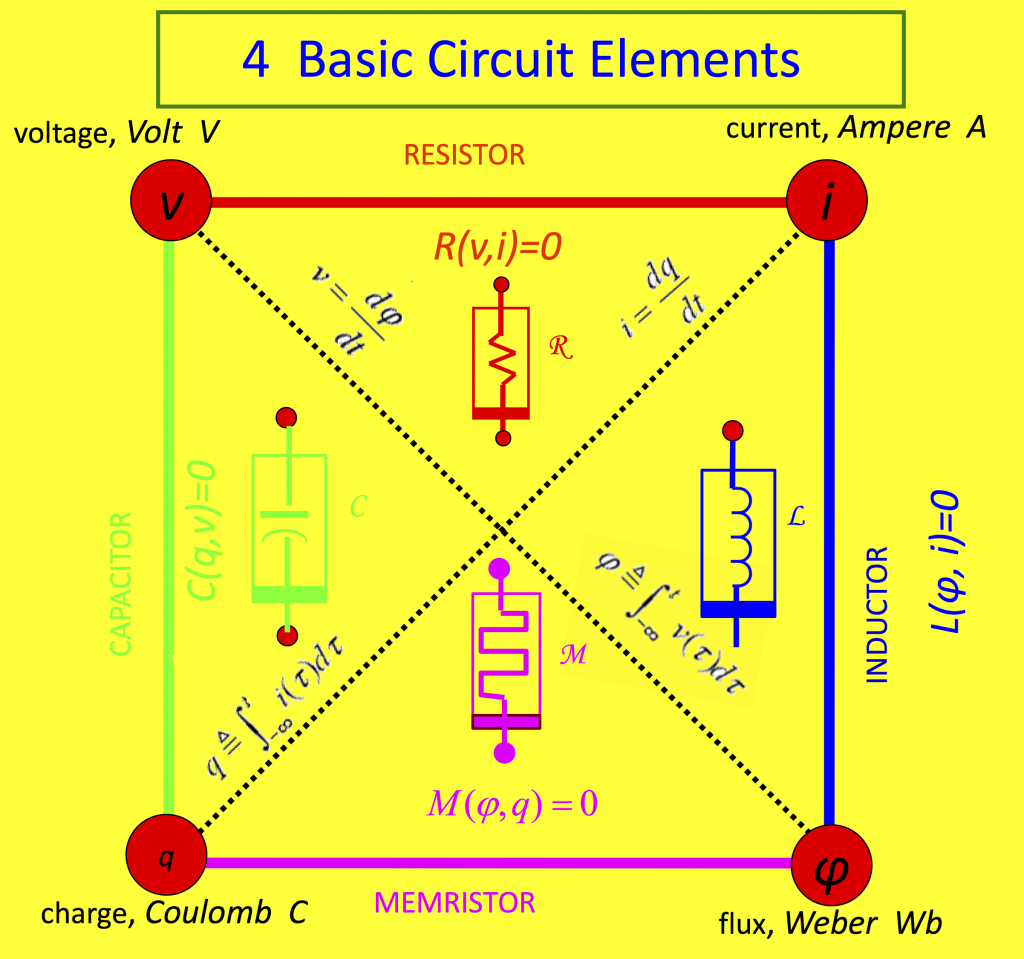
Read MoreMemristors are two-terminal resistive devices with memory. In general, their nonlinear dynamic behaviour is mathematically modeled by means of a differential algebraic equation (DAE) set, in which an ordinary differential equation (ODE) governs the time evolution of the memory state, while an algebraic relation captures the state- and input-dependent Ohm law. The memristor, an acronym for memory resistor, was theoretically introduced in 1971 by L.O. Chua, whom the Chua Memristor Center (CMC) is dedicated to. The memristor introduced in the 1971 pioneering paper, presently referred to as ideal memristor, is the fourth fundamental two-terminal circuit element, the other three being the resistor, the capacitor, and the inductor, as shown in Fig. 1.
The Chua Memristor Center (CMC) combines theoretical and experimental studies for the development of novel forms of computation based upon the nonlinear dynamics of memristors (and RRAMs).

Prof. Dr. Ronald Tetzlaff